
Understanding AAC: What You Should Know

Updated: Aug 26
What is AAC?
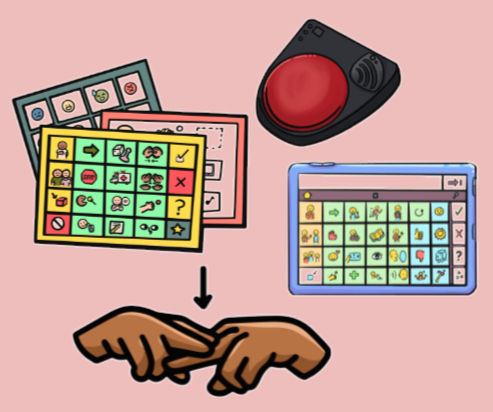
AAC stands for Augmentative and Alternative Communication. AAC includes any method of communication that supplements or replaces spoken language.
Communication can take many forms, including gestures, facial expressions, manual signs or American Sign Language (ASL), writing, drawing, communication boards, single-message devices, and high-tech speech-generating devices (SGDs).
AAC is not a "last resort." Instead, it provides individuals with a reliable way to express their thoughts, wants, needs, and ideas while supporting the development or rehabilitation of language and meaningful communication.
Why Should I Consider AAC?
AAC systems range from simple picture symbols used to communicate immediate wants and needs to robust language systems that allow individuals to express complex thoughts, ask questions, tell stories, and participate fully in conversations.
AAC may be appropriate if your family member:
Has significant delays in speech or language development
Is minimally speaking or non-speaking
Is difficult for unfamiliar listeners to understand
Has a medical or physical condition that limits speech production
Benefits from additional support to communicate consistently across environments
Every person deserves access to effective communication. AAC can reduce frustration, increase independence, and create more opportunities for learning, social interaction, and participation in daily life.
Will AAC Prevent My Relative from Speaking?
No.
This is one of the most common misconceptions about AAC. Research consistently demonstrates that AAC does not reduce motivation to speak or interfere with natural speech development. In many cases, AAC actually supports the development of spoken language by providing a strong language foundation and reducing the frustration associated with communication breakdowns.
Even for individuals who use spoken language, AAC can serve as a valuable "backup" communication system. Those who temporarily lose access to speech due to fatigue, stress, illness, or overwhelming emotions may continue communicating effectively using AAC.
The goal of AAC is communication, regardless of the method used.
Is My Child Too Young for AAC?
No.
There are no prerequisite skills or minimum age requirements for introducing AAC. Children do not need to demonstrate certain cognitive, language, or motor skills before AAC can be considered.
Current research supports introducing AAC as early as communication needs are identified. Early access to AAC allows children to participate in language learning during critical developmental periods rather than waiting for spoken language to emerge.
Remember: If they could communicate effectively using speech alone, they would.
AAC does not replace speech—it provides access to communication while supporting language development in whatever form is most effective for the individual.
Is AAC Right for My Relative?
Every person communicates differently, and there is no one-size-fits-all solution. A comprehensive AAC evaluation completed by a speech-language pathologist can determine whether AAC would be of benefit, identify the most appropriate communication system, and recommend the best access method based on your family member's unique strengths and needs.
If you have questions about whether AAC is appropriate for your family, we're happy to help.
References
American Speech-Language-Hearing Association. (n.d.). Augmentative and Alternative Communication (AAC). https://www.asha.org/public/speech/disorders/aac/
Blischak, D. M., Lombardino, L. J., & Dyson, A. T. (2003). Use of speech-generating devices: In support of natural speech. Augmentative and Alternative Communication, 19(1), 29–35.
Drager, K., Light, J., & McNaughton, D. (2010). Effects of AAC interventions on communication and language for young children with complex communication needs. Journal of Pediatric Rehabilitation Medicine, 3(4), 303–310. https://doi.org/10.3233/PRM-2010-0141
Millar, D. C., Light, J. C., & Schlosser, R. W. (2006). The impact of augmentative and alternative communication intervention on the speech production of individuals with developmental disabilities: A research review. Journal of Speech, Language, and Hearing Research, 49(2), 248–264.
Romski, M. A. (2005). Augmentative communication and early intervention: Myths and realities. Infants & Young Children, 18(3), 174–185.


Comments