
AAC: Beyond Requesting

Augmentative and Alternative Communication (AAC) is a valuable support when your kid is non-speaking, is highly unintelligible, or has difficulty reliably communicating their wants/needs, thoughts, or ideas. Options include things like using picture boards, individual picture symbols placed strategically within the environment, manual signs, or high-tech speech generating devices (SGD). No matter the type of AAC being utilized, it is important to consider what communicative functions we are supporting.
Communicative functions include all the reasons why we communicate as humans. This includes requesting, but also includes things like protesting/refusing, commenting, asking questions, sharing information, gaining attention, expressing emotions, and social niceties.
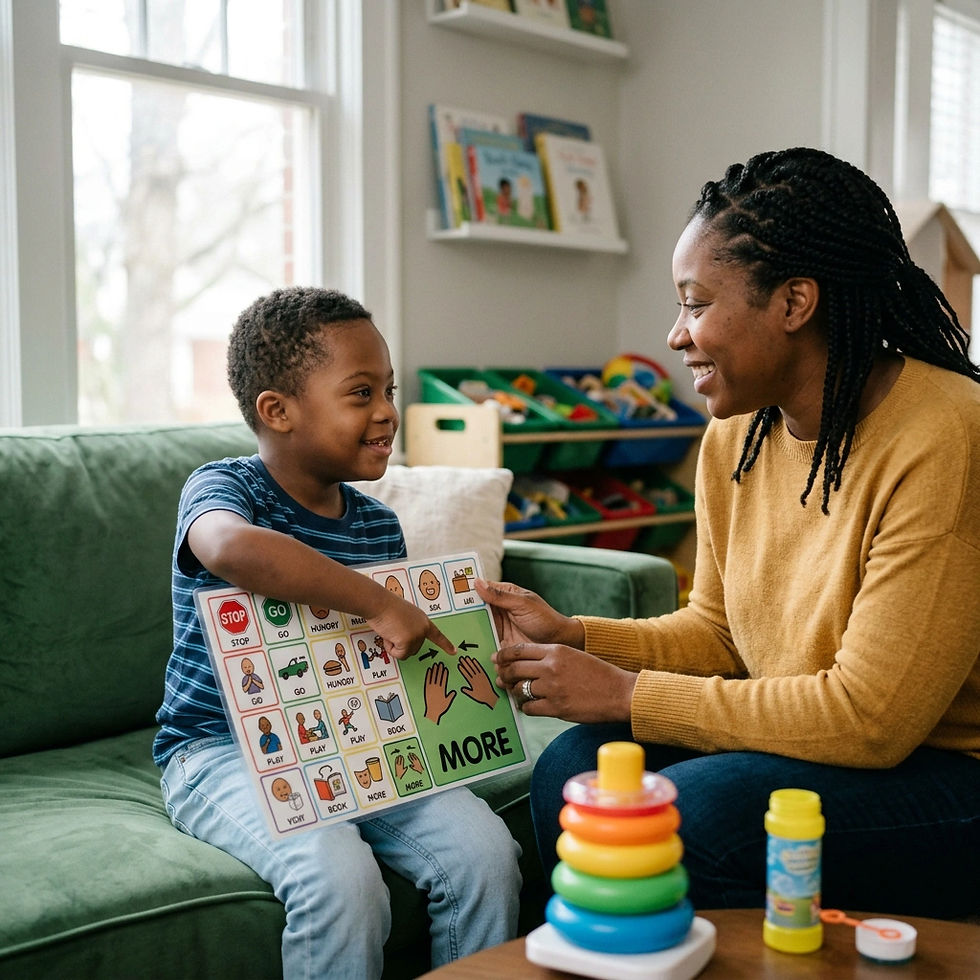
A speech therapist may encourage requesting as a starting point for communication because it leans into the motivation of a child to participate in an activity and is a way to give parents a means to practice at home with things like mealtimes or play routines. However, it is important that we model AAC and language in general for more than requesting.
When requesting is the primary or only way we model AAC, communication can unintentionally become associated with obtaining or giving something. A child may begin to experience AAC as something they are expected to use when an adult wants a response, rather than as a tool they can use to share their own thoughts, feelings, interests, and experiences. Over time, this may communicate the message that AAC is primarily for getting one’s needs met: “I use this when I need something,” rather than “I can use this to tell people what I think, feel, notice, or want to share.”
Try modeling AAC and language throughout daily routines for different communicative functions:
Comment: “Big!”
Protest/refuse: “I don't want that.”
Share information: “Daddy home!”
Ask a question: “Where go?”
Get attention: “Look!”
Express emotion: “I'm happy!”
Social interaction: “Hi!” / “I love you.”
Repair: “No, I mean…”
This provides opportunities for communication that are more natural and conducive to reciprocal exchanges of shared joy and observation, rather than making communication primarily transactional. It gives children opportunities to experience communication as more than a way to get their needs met.
Try this!: In addition to modeling words like “more”, “open”, or “want”, aim to model language that reflects what your child is experiencing. Comment on what you see (“Wow, cool!”), protest (“No, not that one”), share excitement (“I love this!”), get someone's attention (“Look!”), or acknowledge an emotion (“That was funny!”). Your child does not need to imitate every model. Simply providing models gives them more examples on how to communicate.
Be sure to talk to your speech therapist on ways you can encourage AAC using multiple communicative functions!


Comments